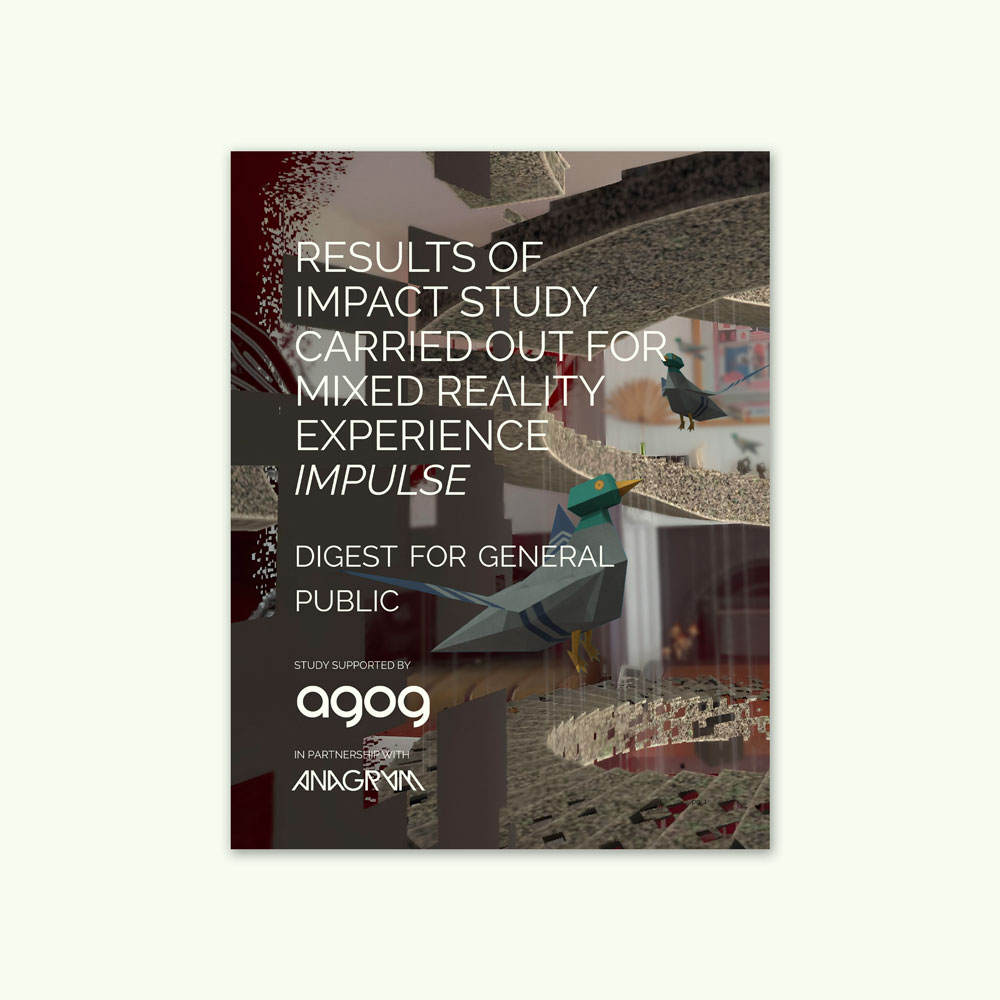
The Impulse Impact Study was commissioned by US philanthropic organisation Agog to rigorously assess the real-world social impact of Anagram’s Mixed Reality experience, Impulse: Playing with Reality.
Impulse was created with the core aims of reducing stigma towards people with ADHD, promoting a nuanced understanding of how the condition manifests, and encouraging a better understanding of life with ADHD. We also hope that the work can be a powerful tool for those with ADHD to better understand behaviours or emotions they experience. This study intended to measure outcomes against those aims, as well as exploring other potential positive behavioural and attitudinal changes resulting from taking part in the work.
To ensure academic rigor and establish statistically significant findings, Anagram partnered with expert researchers, including lead researcher Dr. Alexandra Sierra of XR ACADEMIA and Dr. Sandra Gaudenzi of UCL, to design and execute a comprehensive methodology. This study was not designed to be comparative, i.e. to assess whether Impulse is more effective in its native XR format than in alternative forms such as 2D film or written testimony. Nevertheless, responses relating to first-person gameplay and qualitative references to immersion suggest that aspects of the XR experience are associated with the aims of Impulse.
Greatly supported by Undershed in Bristol, UK, where Impulse was presented from 2 October – 2 November 2025, and by UCL, data was collected from 118 participants. The study’s most critical design feature was its long-term measurement approach: participants completed questionnaires immediately before, immediately after, and, crucially, one month following their experience. This three-stage process allowed us to find out:
a) whether participants expressed any intention to do anything new, or differently, right after experiencing Impulse and
b) whether, one month later, they had followed through on any of those intentions.
The results demonstrated that experiencing Impulse resulted in enduring shifts in knowledge, attitudes, and behavior, with key findings including:
- Lasting Understanding and Knowledge Retention:
The experience was highly effective at giving people a sense of “how ADHD feels and works from the inside,” leading to significant knowledge gains that were retained one month later. - Increased Empathy:
This deep understanding fostered greater empathy, with:- 90% of participants reported increased empathy toward people with ADHD.
- Over 70% of participants demonstrated an increased awareness of the stigma that surrounds ADHD.
- Positive Behavioral Change:
That emotional shift translated into behavioral change, including:- 80% of participants reported behaving with more patience towards people in their lives with ADHD.
- Participants reported adjusting schedules, environments and communication styles to better support people in their lives with ADHD.
- Over 50% of participants who suspected they had ADHD symptoms had sought support from a doctor or counsellor.
—-
Interested in the methodology behind the findings?
Access the full research details here, including study design, participant demographics, survey measures and statistical analysis, for a deeper understanding of how the Impulse Impact Study was conducted.
Alongside the report, we have also released a short film featuring participants reflecting on how Impulse continued to affect them long after the headset came off. Hear directly from some study participants and learn more about the results from this short video, shot at Undershed: